 B6 Brief
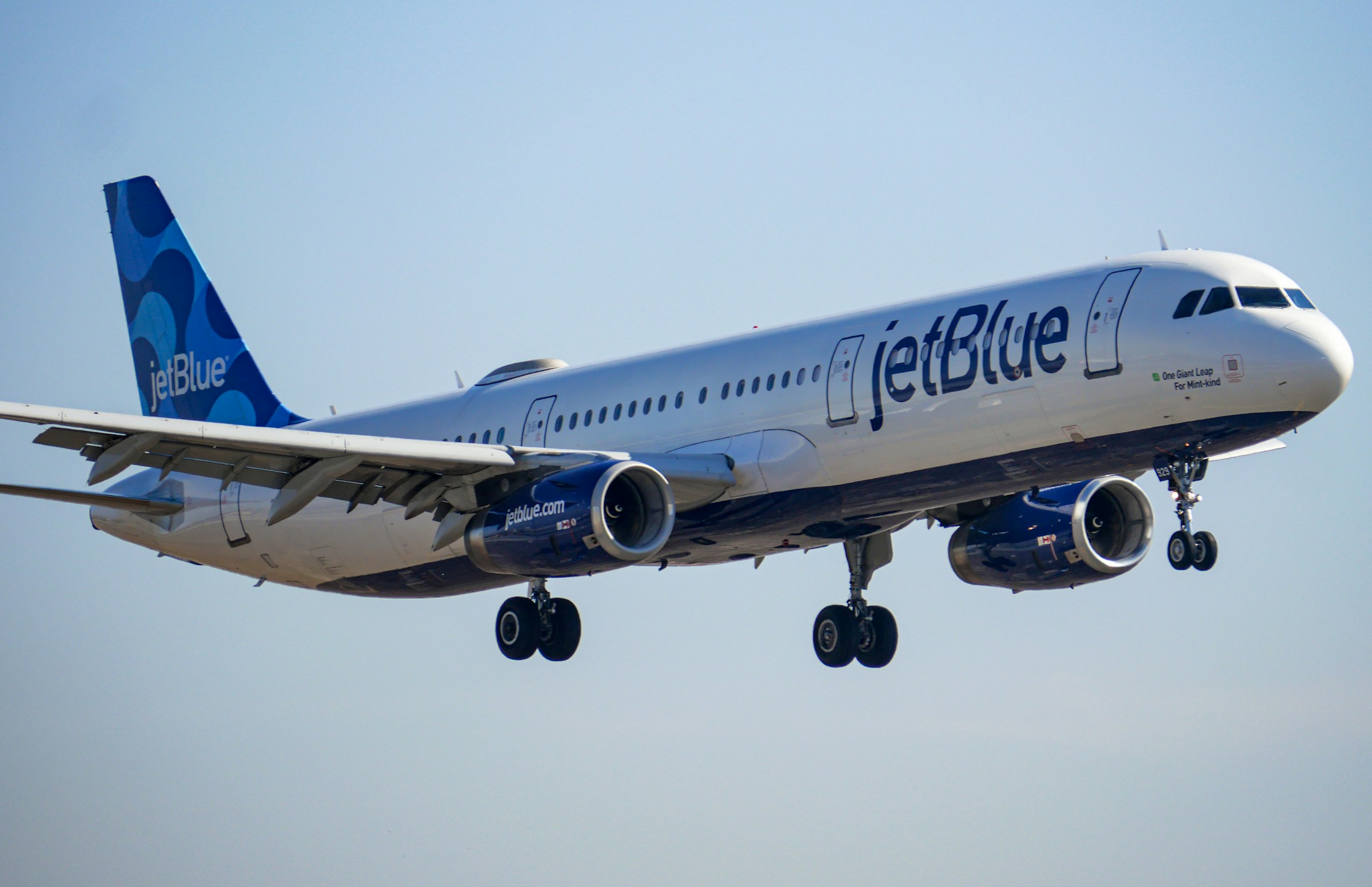
Here is a brief overview, if you suddenly find you are assigned a 321.
This is unofficial data, for general information only!
Takeoff
- Slight backpressure to rotate. Let it fly off, then set to target pitch.
- Do not rotate early!
- Do not over-rotate!
- At heavy weights, Auto Flap Retraction may occur as you accelerate. This may catch you by surprise on occasion. Just realize it is normal, and as usual, still call for Flaps 0 at S speed or above. This is a good briefing item for departure.
Landing
- Sight picture about the same as the 320.
- Less flare at the end, just enough to break the descent. But don’t flare too late either.
- Do not hold it off trying to get a “greaser”. (Tail strike caution)
- If you get a true bounce, go around — don’t try to save it. (Tail strike caution)
Cruise
- Expect lower initial filed altitudes than you are used to, due to weight on longer flights.
- Declare Minimum Fuel at EFOB :45. (Verify :45 in DIAFRIPS INIT B – FINAL FUEL)
- Declare Emergency Fuel at EFOB :30.
Descents
Plan your descents early. If you are heavy and near the max recommended altitude, your margin between Vls and Vmax will be thin. In this condition it is easy to overspeed, and the speed brake won’t help either, as it will increase Vls.
Once you get to a lower altitude, like the 320, the margin will widen and you have room to maneuver. Full speed brakes are available with the autopilot on.
Aircraft
- 23 feet longer.
- 8 doors unarmed at the gate. (There are no overwing exits that stay armed as on the A320)
- Tail swings wider than the wingtip.
- 91 feet of pavement to do a 180.
- All with Sharklets.
- All with RA1 software.
Weight & Balance
| Max Taxi | 207,014 lbs |
|---|---|
| Max Takeoff | 206,132 lbs |
| Max Landing | 171,500 lbs |
| Max ZFW | 162,701 lbs |
| Min Weight | 104,720 lbs |
The maximum combined total of adults and children in each zone is as follows. If you get an error, you have exceeded the max for that zone!
Example: on the 200-seat aircraft, if Zone A (max 52) is full with 1 child, it should be 51 adults + 1 child.
High Density Aircraft (Non-Mint): 200 Total, 34 Rows
| Zone | Max | Rows |
|---|---|---|
| A | 52 | 1–9 |
| B | 36 | 10–15 |
| C | 40 | 16–22 |
| D | 36 | 23–28 |
| E | 36 | 29–34 |
High Density Aircraft (Non-Mint): 190 Total, 32 Rows
| Zone | Max | Rows |
|---|---|---|
| A | 53 | 1–9 |
| B | 24 | 10–13 |
| C | 48 | 14–21 |
| D | 11 | 22–23 |
| E | 54 | 24–32 |
Low Density Aircraft (Mint): 159 Total, 29 Rows
| Zone | Max | Rows |
|---|---|---|
| A | 16 | 1–5 |
| B | 30 | 6–10 |
| C | 42 | 11–17 |
| D | 11 | 18–19 |
| E | 60 | 20–29 |
RDR-4000 Weather Radar
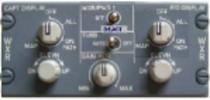
Most A321 and newer A320 aircraft will have this new Honeywell radar installed. Set it … and forget it, almost!
- The complete guide is in MyMobile365 > Collections > FLT A320/A320 Publications.
- The 3 top switches are the primary controls.
- Avoid the constant use of PATH; it does not look at the FMGC planned path.
- MAP is a good way to test for returns and detect shadows.
- Ground clutter is filtered out.
- There is no tilt.
- Surface to 60,000′ is constantly scanned.
- Windshear and radar power is on a single switch (WXR/PWS). First Officers: this is the switch you turn ON after the flight control check.
If you need the radar:
- CAPT & F/O switches to ALL.
- WXR/PWS: verify the switch is already set to 1.
Turn OFF the radar & PWS after landing: all 3 switches (OFF – OFF – OFF).
Note: if both display switches are OFF and the WXR/PWS switch is on, the radar is not transmitting. This would be the normal setup cruising along on a clear day (OFF – 1 – OFF).
Seatbelt Sign – Auto Position
On A321 N903 and up, the Fasten Seat Belt switch now has an Auto function. Auto will turn off the FSB sign unless the gear is down or the flaps leave the up position. There are other activities that will also turn ON the FSB sign in Auto.
Until further notice, current SOP is to just use the On or Off position.
Autopilot
- 900′ all other phases.
- FMS Visuals are the main concern here: AP off at 900′ + elevation.
- Not a big deal in SFO.
- LGA RNAV 31 Visual: AP off during the turn to final is more difficult for the F/O to see.
Single Engine Cat II Autoland
- A320: Full flaps only.
- A321: Config 3 or Full.
Single reverser during auto rollout:
| Classic 320 A/C | No limitation |
|---|---|
| Sharklet | Idle only |
| A321 | Crosswind 15 knots or less, and idle only |
So the above means the A321 can do a single engine Cat II auto rollout with:
- Idle reverse thrust only.
- Flaps 3 or Full.
Flap Speeds
| Flaps | Speed |
|---|---|
| 1 | 235 |
| 2 | 215 |
| 3 | 195 |
| Full | 190 |
Fuel Imbalance
The 321 and all Sharklet aircraft have different imbalance limitations. Refer to the QRH. The 321 imbalance limit for takeoff is only 882 lbs.
Speed Brakes
- Full is available with the AP on.
- Inhibited with Flaps 3 or Full.
ECON Pack Flow
ON when fewer than 140 customers. (Mint aircraft: 115, same as the A320)
Fuel System
It is important to understand the fuel differences, as there is a lot of fuel transferring going on. Understand the differences in the fault warnings.
- 41.2 usable (without the ACT installed). (80 lbs less usable than the A320)
- No outer tanks to transfer.
Fuel Feed
- Cabin air is fed to ACT 1 & 2 to provide transfer head pressure. A backup electric pump is used if needed.
- ACT 2 transfers to CTR, then ACT 1 transfers to CTR.
- CTR motive flow is pumped to the wings. (Wing pumps provide the motive flow pressure)
- Wings are electrically pumped to the engines.
- All fuel feed comes from the wing tanks. (CTR transfers to the wings via jet pumps)
- Green arrow = valves open.
Fuel Panel
The CTR pumps now read XFER.
| Mode – Dark | Xfer valves auto (normal) |
|---|---|
| Mode – Man | Valves operated by switches |
| Mode – Fault | CTR more than 550, either wing under 11,000 |
| Xfer switch – Fault | Wing tank is overflowing (ECAM also) |
| Xfer switch – OFF | Xfer valve closed |
Manual mode caution: Xfer switches OFF when the wing tanks are full or CTR is empty. It is easy to overflow tanks, so monitor carefully.
2 ACT Tanks
- Extra 5,200 lbs each.
- The center tank must be full if scheduled for any ACT fuel. (Unless relief is provided by an MEL)
- Transfers to the CTR tank after slat retraction.
- ACT 2 is used first, then ACT 1.
| ACT switch – Dark | ACT valves auto (normal) |
|---|---|
| ACT switch – FWD | Manually transfers fuel to CTR (valve, valve, electric backup pump) |
| ACT switch – Fault | CTR less than 6,614, ACT more than 550 |
Popular Fuel System Oral Question
If both electric fuel pumps are inop in the left wing tank, and all tanks including 2 ACTs are full:
- Can all the fuel be used, assuming no other failures?
- If yes, explain how and in what order fuel is fed to the engines while remaining in balance.
- If no, explain why not.
(If you can answer this question, you understand the A321 fuel system differences.)
Tail Strike
11.2 degrees pitch (PFD visual and aural warnings).